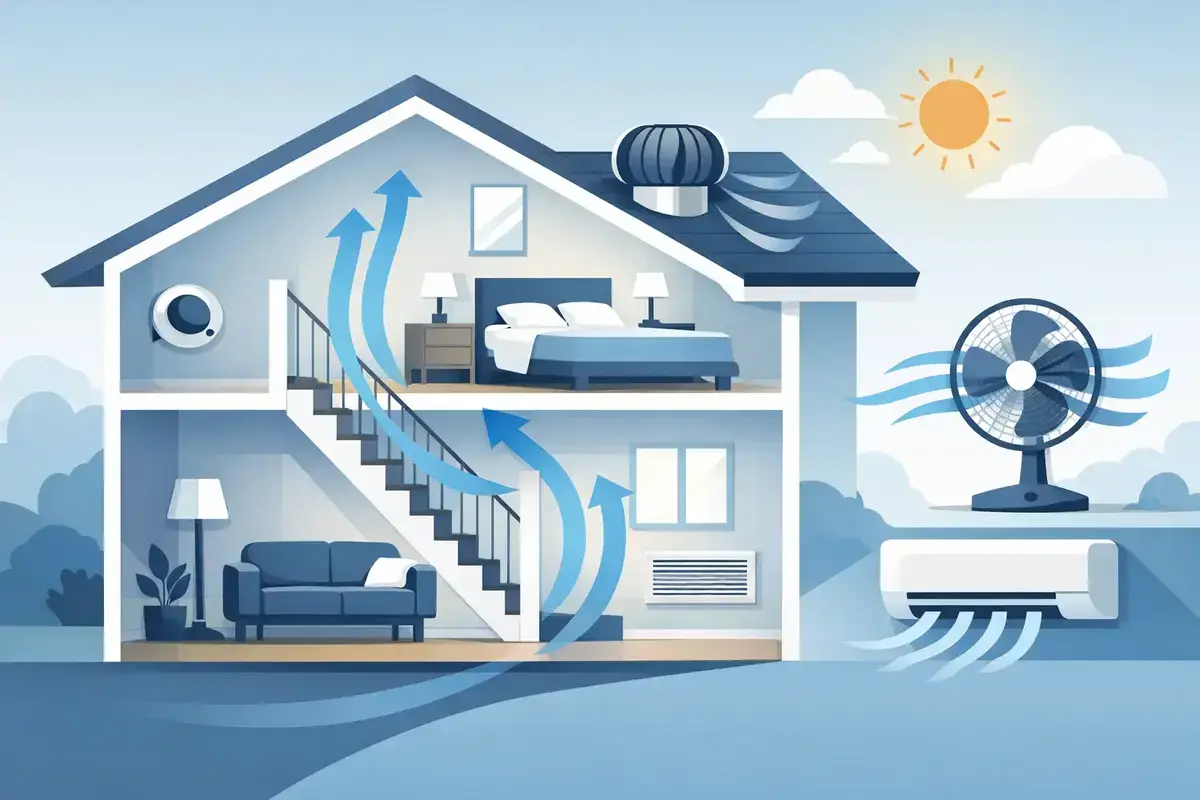
A second floor that stays warm while the downstairs feels comfortable is one of the most common comfort complaints in North Texas homes. If you are asking how to improve airflow upstairs, the answer is rarely as simple as buying a stronger fan or lowering the thermostat. Airflow problems can involve your thermostat settings, filters, ductwork, insulation, equipment sizing, or the way heat collects around the upper level.
The right fix starts with identifying what is actually limiting comfort. Some adjustments are safe for homeowners to make right away. Others require a trained HVAC technician to measure airflow, inspect the system, and recommend a repair or improvement that makes sense for the home.
Why Upstairs Rooms Often Feel Hotter
Heat rises, but that is only part of the story. Upstairs rooms are closer to the roof, where attic heat can transfer through ceilings and walls. In Dallas-area summers, an attic can become significantly hotter than the outdoor temperature. If insulation is thin, displaced, or incomplete, that heat works its way into bedrooms and living spaces below.
Upper floors also tend to have longer duct runs. The farther conditioned air has to travel, the more likely it is to lose volume through duct leakage, poor connections, restrictive bends, or inadequate duct sizing. A system that serves both floors from one thermostat may also stop cooling before the upstairs has reached a comfortable temperature because the thermostat downstairs is already satisfied.
Before changing vents or replacing equipment, pay attention to the pattern. Is every upstairs room uncomfortable, or only one? Does the problem happen only in the afternoon? Is airflow weak from the registers, or is there plenty of air that simply is not cold enough? Those details help point to the cause.
How to Improve Airflow Upstairs: Start With Simple Checks
Begin with the basic items that can restrict circulation throughout the home. Check the air filter first. A clogged filter reduces the amount of air your system can move and can strain the blower motor. Most standard filters should be checked monthly and replaced as needed, especially during heavy cooling season. Use the filter type recommended for your system. A highly restrictive filter may capture more particles, but it can create airflow issues if the system was not designed for it.
Next, make sure supply registers and return grilles are open and unobstructed. Furniture, rugs, curtains, and stored items can block air from entering or leaving a room. Supply registers deliver conditioned air. Return grilles pull room air back to the HVAC system to be cooled again. Both need clear space to do their job.
It is tempting to close vents downstairs to force more air upstairs. This may help slightly in a few homes, but closing too many registers can raise static pressure in the duct system. That can reduce overall airflow, increase noise, and place added stress on the equipment. Instead of closing registers completely, try modest adjustments while monitoring comfort. If changes make the system louder or rooms stuffier, return the registers to their original position.
Ceiling fans can make an upstairs room feel more comfortable even though they do not lower the room temperature. In summer, the blades should turn counterclockwise when viewed from below, creating a downward breeze. Use fans only in occupied rooms, since they cool people rather than the space itself.
Help Air Move Between Floors and Rooms
A room needs a path for supply air to return to the system. Bedrooms with closed doors often become uncomfortable because air is delivered through a supply register but cannot easily escape to reach the central return. You may notice pressure at the door when the system runs, or a room that becomes stuffy even when the register is open.
For a quick test, leave the bedroom door open while the air conditioner is running. If comfort improves noticeably, the room may need a better return-air path. Depending on the layout, an HVAC professional may recommend a dedicated return, a jump duct, a transfer grille, or another properly designed solution. Door undercuts alone are often not enough for rooms with high airflow needs.
Keeping interior doors open during the hottest part of the day can also improve circulation in homes without adequate returns. It is not always practical, particularly for bedrooms, but it can help confirm whether poor air return is contributing to the problem.
Check the Attic and Ductwork
When the upstairs is consistently hotter than the lower level, the attic deserves attention. Look for obvious signs of inadequate insulation, such as exposed ceiling joists, uneven coverage, or areas that have been compressed by foot traffic. Air leaks around attic hatches, recessed lighting, plumbing penetrations, and wiring openings can allow hot attic air into the living space.
Ductwork in an unconditioned attic is another frequent source of trouble. Leaky ducts can spill cooled air into the attic before it reaches upstairs rooms. Loose or disconnected ducts, damaged insulation, and poorly sealed joints are not always visible from the living space, but they can have a major effect on comfort and energy use.
Duct repair is not a guesswork project. A technician can inspect accessible runs, check for damaged connections, and evaluate whether the ducts are sized and routed appropriately. In older homes and additions, ducts may have been modified over time without being redesigned for the current load. Simply increasing blower speed or adding a larger air conditioner will not correct undersized or leaking ductwork.
Use Thermostat Settings Carefully
A single thermostat can struggle to control two levels with different heat loads. If it is located downstairs, it may reach its set temperature while the upstairs is still several degrees warmer. Setting the thermostat much lower can cause longer run times and higher utility bills without fully solving the imbalance.
A programmable or smart thermostat can help by maintaining more consistent schedules, but it cannot overcome a distribution problem by itself. Avoid large temperature setbacks during a hot day. Allowing the house to warm substantially while no one is home can make it harder for the upstairs to recover by evening.
For homes with persistent floor-to-floor temperature differences, zoning may be worth evaluating. A zoned HVAC system uses separate thermostats and controlled dampers to direct cooling where it is needed. Zoning works best when the equipment, duct design, and controls are properly matched. It is not the right answer for every house, but it can provide meaningful comfort in multi-level homes.
When a Ductless Mini-Split Makes Sense
If one upstairs bedroom, bonus room, or finished attic is the main problem, a ductless mini-split can be a practical option. These systems provide independent cooling and heating for a specific area without requiring major duct alterations. They can be especially useful for room additions, converted garages, and spaces that were never well served by the original central system.
A mini-split is not automatically the first choice. If the entire upstairs lacks airflow, correcting duct leakage, return-air issues, insulation gaps, or equipment problems may provide a more complete solution. The best approach depends on the home’s layout, existing system condition, and long-term plans.
Know When to Schedule an HVAC Evaluation
Call for professional service if upstairs registers have noticeably weak airflow, your system runs constantly without catching up, rooms have large temperature differences, or you hear whistling and banging from the ducts. These can indicate problems that should not be addressed by trial and error, including a failing blower, dirty indoor coil, refrigerant issue, duct restriction, or poor system design.
An HVAC evaluation should look beyond the outdoor unit. A qualified technician can inspect filters, blower performance, refrigerant operation, duct condition, return-air capacity, insulation concerns, and thermostat placement. That process helps separate a simple maintenance need from a project such as duct repair, zoning, or system replacement.
For homeowners who want dependable answers rather than a quick guess, M.B. Kiser Heating and Air Conditioning Co. Inc. brings decades of Dallas HVAC experience to diagnosing uneven comfort and airflow concerns. A properly evaluated system can cool your upstairs more effectively while helping protect equipment reliability.
Start with the simple checks, but do not ignore an upstairs that remains uncomfortable season after season. Consistent airflow is a whole-home issue, and the right correction can make bedrooms, offices, and family spaces more comfortable when Texas heat is at its worst.