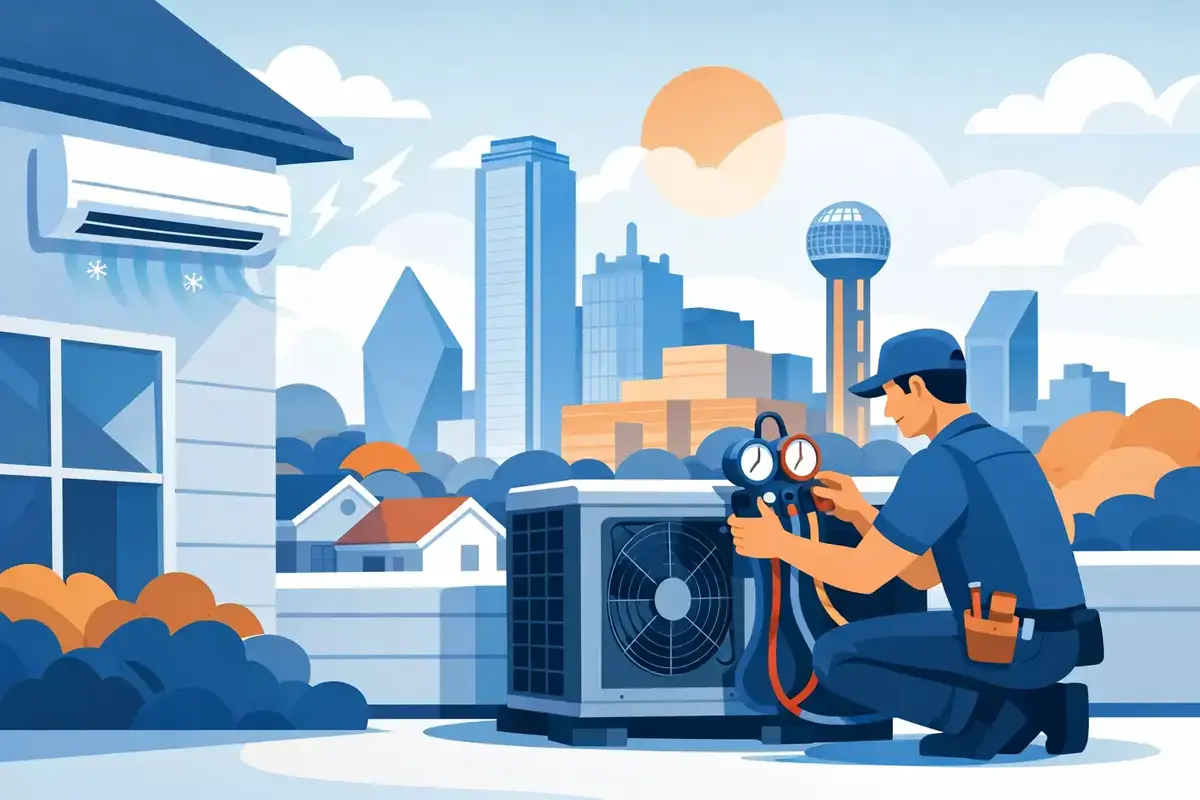
When your air conditioner quits in the middle of a Dallas summer, comfort stops being the issue for long. Indoor temperatures rise fast, humidity builds, and what starts as an inconvenience can turn into a health, safety, and property concern within hours. That is why emergency AC repair Dallas property owners look for is not just about speed. It is about getting the problem diagnosed correctly and fixed by technicians who know how to work under pressure.
In North Texas, emergency calls tend to follow a familiar pattern. A system runs hard through days of extreme heat, then suddenly stops cooling at night, on a weekend, or right before a business opens. Sometimes the unit is blowing warm air. Sometimes it will not turn on at all. In other cases, you hear unusual noises, smell something burning, or notice water where it should not be. Those are all signs that waiting may cost more than acting quickly.
When AC problems become an emergency
Not every air conditioning issue is a true emergency, but some clearly cross that line. If your system has stopped cooling during high heat, especially in a home with young children, older adults, or anyone with medical concerns, prompt service matters. The same is true if your business depends on climate control for staff, customers, equipment, or inventory.
There are also mechanical signs that should never be ignored. Electrical smells, tripped breakers that keep resetting, ice on the indoor coil, loud grinding or screeching sounds, or water leaking around the air handler can point to problems that may worsen quickly. In a commercial space, poor airflow or a failed packaged unit can affect operations almost immediately.
The hard part is that some failures look minor at first. A clogged drain line may seem like a small issue until water damage appears. Low refrigerant may start as weak cooling but can lead to compressor strain. A failed capacitor may be a fast repair, while a burned contactor or motor issue can require more involved service. That is why a proper diagnostic matters as much as a fast arrival.
What to check before calling for emergency AC repair in Dallas
A quick check can save time, and in some cases, it may reveal a simple issue. Start with the thermostat. Make sure it is set to cool and the temperature is lower than the room temperature. If the screen is blank, the batteries may be dead or the unit may have lost power.
Next, check the circuit breaker. If the AC breaker has tripped once, reset it one time. If it trips again, stop there. Repeated resets can point to an electrical problem that needs professional attention.
Look at the air filter too. A severely clogged filter can choke airflow and cause freezing or poor cooling. If the filter is dirty, replacing it may help, but it will not solve every problem. If you see ice on the refrigerant lines or indoor equipment, turn the system off and switch the fan to on if possible. That can help the coil thaw while you wait for service.
Also check the outdoor unit. If it is covered in debris, blocked by overgrowth, or not running while the indoor blower operates, that is useful information to relay when you call. The goal is not to self-diagnose beyond reason. It is to give the technician a clearer starting point and avoid overlooking a simple fix.
What usually causes an emergency AC repair call
In Dallas, heavy cooling demand exposes weak components quickly. Capacitors and contactors often fail during peak summer operation because they absorb repeated electrical stress. Blower motors and condenser fan motors can also wear down after long run cycles, especially in older systems.
Refrigerant issues are another common cause. A system low on refrigerant may still run, but it will not cool properly and can eventually freeze up or overwork key components. Refrigerant leaks are never normal, and topping off a system without finding the leak is not a real repair.
Drain line clogs are common in humid conditions. When condensation cannot exit properly, water backs up and may trigger a safety shutoff. That can leave a homeowner with a system that appears dead when the actual issue is moisture management.
Electrical faults, failed thermostats, dirty coils, and neglected maintenance also contribute. For commercial properties, control issues, rooftop unit failures, and ventilation-related problems often add another layer of complexity. The bigger point is simple: emergency service should address the root cause, not just restart the equipment.
What good emergency AC repair Dallas service should look like
When you call for emergency service, you should expect more than a rushed visit. A dependable HVAC company asks the right questions up front, arrives prepared, and explains what it finds in clear terms. That includes what failed, why it failed, whether there is collateral damage, and what repair options make sense.
A good technician also understands when repair is the right move and when it is not. In many cases, an emergency repair is absolutely the best option, especially if the problem is isolated and the system still has solid service life left. But if an older unit has a major compressor issue, repeated refrigerant leaks, or expensive multi-part failures, a homeowner may need to weigh repair costs against replacement.
That is where experience matters. Honest service means recommending the practical option, not the most expensive one. For a business owner, that may mean restoring operation quickly now and planning a replacement strategically later. For a homeowner, it may mean repairing a failed part today and discussing preventive maintenance so the same breakdown does not happen again next month.
Why local experience matters in Dallas
Emergency HVAC service is always local. Dallas homes and commercial properties deal with long cooling seasons, high summer loads, dust, aging ductwork in older neighborhoods, and a wide mix of equipment types. A technician working in Preston Hollow or Highland Park may see very different system configurations than one servicing a retail property in Irving or a light commercial site in Las Colinas.
That local knowledge affects response and results. It helps when a company is familiar with common system designs in the area, understands how heat waves stress equipment, and has experience with everything from standard split systems to ductless mini-splits, heat pumps, packaged units, and more specialized setups. M.B. Kiser Heating and Air Conditioning Co. Inc. has built its reputation around exactly that kind of long-term technical capability.
Repair now or replace soon?
This is one of the most common questions during an emergency call, and the honest answer is that it depends. If your system is newer and the repair is straightforward, fixing it is often the obvious choice. If the unit is older, out of warranty, and facing a costly failure, replacement may be the better long-term value.
Still, emergencies are not always the best time to make a rushed replacement decision. Sometimes the right move is to complete a safe, cost-effective repair, restore cooling, and then evaluate the system carefully once the immediate pressure is off. Other times, particularly with chronic breakdowns or major compressor damage, putting more money into the old equipment does not make financial sense.
A trustworthy contractor will walk through those trade-offs clearly. You should know what the repair solves, what it does not solve, and what to expect next.
How to reduce future emergency AC repairs
No system can be guaranteed against every failure, especially in extreme Texas heat, but preventive care lowers the odds. Regular maintenance helps identify weak electrical components, refrigerant issues, drainage problems, dirty coils, airflow restrictions, and wear on motors before those conditions lead to a no-cooling call.
Homeowners can help by changing filters on schedule, keeping supply and return vents clear, watching for rising humidity or weak airflow, and paying attention to unusual sounds. Commercial operators benefit from planned service even more because downtime carries a broader cost. A maintenance agreement often pays for itself by reducing disruption and extending equipment life.
If your AC does fail unexpectedly, the best outcome usually comes from acting early. Waiting through a hot Dallas day in hopes that the system recovers on its own rarely ends well. Small issues become larger repairs, and the indoor environment only gets harder to manage.
When you need emergency AC repair in Dallas, the right call is a company that treats urgency seriously, diagnoses thoroughly, and gives you a clear path forward. Fast service matters, but confidence in the repair matters more when the temperature outside is still climbing.